

-
1 factor
1. коэффициент (see also coefficient)2. показатель (see also index)3. фактор4. множительassurance factor — коэффициент запаса ( прочности)
breaking factor — коэффициент сопротивления разрыву
bulk factor — 1) объёмный фактор 2) коэффициент уплотнения
compacting factor — коэффициент уплотнения
compressibility factor — коэффициент сжимаемости
coupling factor — коэффициент сцепления [связи]
damping factor — коэффициент демпфирования
decontamination factor — коэффициент очистки
dielectric loss factor — коэффициент потерь в диэлектрике
dielectric power factor — коэффициент потерь в диэлектрике
dynamic factor — 1) коэффициент перегрузки 2) динамический коэффициент
elastic stress concentration factor — коэффициент концентраций упругих напряжений
environmental factor — фактор окружающей среды
erosion factor — эрозионный коэффициент
expansion factor — коэффициент расширения
fatigue notch factor — отношение усталостной прочности образца без надреза к усталостной прочности образца с надрезом
filling factor — коэффициент заполнения
flexibility factor — коэффициент жёсткости
friction factor — коэффициент трения
heat-stretch factor — коэффициент теплового удлинения
irradiation factor — фактор облучения
mass-transfer factor — коэффициент переноса массы
material factor — коэффициент запаса ( прочности)
notch factor — 1) коэффициент надреза 2) фактор надреза
orientation factor — фактор ориентации ( волокон)
packing factor — коэффициент упаковки
plastic constraint factor — коэффициент пластического стеснения
plasticity factor — коэффициент [показатель] пластичности
plastic stress concentration factor — коэффициент концентрации пластических напряжений
processing factor — технологический фактор
quality factor — 1) качественный фактор 2) коэффициент качества
recovery factor — коэффициент восстановления
reflection factor — коэффициент отражения
resilience factor — коэффициент упругости
rigidity factor — жёсткость
roughness factor — коэффициент шероховатости
safety factor — коэффициент безопасности, запас прочности
sensitivity factor — коэффициент чувствительности ( материала)
shrinkage factor — коэффициент усадки
slip factor — коэффициент скольжения
solar irradiation factor — фактор солнечного облучения
solubility factor — коэффициент растворимости
sound absorption factor — коэффициент звукопоглощения
space factor — коэффициент заполнения [упаковки]
static fatigue factor — характеристика статической усталости
stiffness factor — жёсткость
strength factor — коэффициент прочности
strengthening factor — коэффициент упрочнения
stress concentration factor — коэффициент концентрации напряжений
stress intensity factor — коэффициент интенсивности напряжений
surface quality factor — коэффициент качества поверхности
tear factor — показатель сопротивления раздиранию
temperature factor — температурный коэффициент
theoretical stress concentration factor — теоретический коэффициент концентрации напряжений
thermal diffusion factor — коэффициент термодиффузии
thermal stress concentration factor — коэффициент концентрации термических напряжений
void factor — коэффициент уплотнённости [пустотности], процент пустот
English-Russian dictionary of aviation and space materials > factor
-
2 displacement power factor
- коэффициент мощности, не учитывающий высшие гармоники
коэффициент мощности, не учитывающий высшие гармоники
-
[Интент]EN
displacement power factor
DPF
The displacement power factor is the power factor due to the phase shift between voltage and current at the fundamental line frequency. For sinusoidal (non-distorted) currents, the displacement power factor is the same as the apparent power factor.
[ http://www.ccontrolsys.com/w/Power_Factor]
displacement power factor
The ratio of real to apparent power for an inductive or capacitive linear load. (Displacement Power Factor= kilowatts60 Hz / kilovoltamps60 Hz, or FP (displacement) = kW60Hz / kVA60 Hz). For an inductive load the current lags the voltage and the power factor is called “lagging.” For a capacitive load the current leads the voltage and the power factor is called leading. In all cases if the current and voltage are in phase, the displacement power factor is unity (1). Displacement power factor ranges from unity to zero. The value of displacement power factor is also given by the cosine of the angle by which the current lags or leads the voltage. (see: Leading; Lagging; Linear Load; Power Factor.)
[ http://harmonicslimited.com/glossary/term/40]
displacement power factor
Displacement factor is equal to the power factor for linear loads with sinusoidal voltages and currents.
pf = cos (angle1 - angle2)
[ http://wiki.answers.com/Q/What_is_displacement_factor]Тематики
EN
- displacement P.F.
- displacement PF
- displacement power factor
- DPF
Англо-русский словарь нормативно-технической терминологии > displacement power factor
-
3 types of power factor correction
виды коррекции коэффициента мощности
-There are 2 types of power factor correction: fixed or automatic.
Fixed power factor correction consists of inserting, in parallel on the network, a capacitor bank whose total power is provided by the assembly of capacitors of identical or different ratings. The bank is energized by a contactor that simultaneously supplies all the capacitors (a single step).
The inrush current peak, in the case of fixed correction, can reach 30 times the nominal current of the capacitor bank.
An automatic power factor correction system, on the other hand, consists of several capacitor banks of identical or different ratings (several steps), energized separately according to the value of the power factor to be corrected.
An electronic device automatically determines the power of the steps to be energized and activates the relevant contactors.
The inrush current peak, in the case of automatic correction, depends on the power of the steps already on duty, and can reach 100 times the nominal current of the step to be energized.
[ABB]
PFC Types
There are two types of Power Factor Correction - Passive PFC and Active PFC.
Passive PFC uses passive elements like a ferrite core inductor on the AC input. It is very easy to implement in existing power circuits although the power factor is low at 60-80%. The proper AC input voltage (115V or 230V) must also be chosen manually. In addition, significant EMI can still result with a 115V AC source. Of course, a 230V AC source will not have this problem!.
Active PFC, on the other hand, uses a switching regulator with active elements like an IC, FETs (Field Effect Transistors) and diodes to create an active PFC circuit. This circuit allows the power supply to achieve a power factor of up to 95%, significantly reduce harmonics and automatically adjusts the AC input voltage. This means you do not have to manually select the AC input voltage. It works with all voltages from 110V to 240V.
[ http://www.techarp.com/showarticle.aspx?artno=81&pgno=1]
Тематики
EN
Англо-русский словарь нормативно-технической терминологии > types of power factor correction
-
4 partial factor for material properties, also accounting for model uncertainties and dimensional variations
частный коэффициент надёжности по материалу
gM
—
[Англо-русский словарь по проектированию строительных конструкций. МНТКС, Москва, 2011]Тематики
Синонимы
- gM
EN
- partial factor for material properties, also accounting for model uncertainties and dimensional variations
Англо-русский словарь нормативно-технической терминологии > partial factor for material properties, also accounting for model uncertainties and dimensional variations
-
5 abiotic factor
абиотический фактор
—
[ http://www.eionet.europa.eu/gemet/alphabetic?langcode=en]EN
abiotic factor
Physical, chemical and other non-living environmental factors. They are essential for living plants and animals of an ecosystem, providing the essential elements and nutrients that are necessary for growth. The abiotic elements also include the climatic and pedologic components of the ecosystem. (Source: LBC / WRIGHT)
[http://www.eionet.europa.eu/gemet/alphabetic?langcode=en]Тематики
EN
DE
FR
Англо-русский словарь нормативно-технической терминологии > abiotic factor
-
6 power factor compensation
компенсация коэффициента мощности
—
[Я.Н.Лугинский, М.С.Фези-Жилинская, Ю.С.Кабиров. Англо-русский словарь по электротехнике и электроэнергетике, Москва, 1999 г.]Тематики
- электротехника, основные понятия
EN
компенсация реактивной мощности
-EN
reactive power compensation
an action to optimize the transmission of reactive power in the network as a whole
[МЭС 603-04-28]FR
compensation de l'énergie réactive
action dont le but est d'optimiser globalement le transport d'énergie réactive dans le réseau
[МЭС 603-04-28]Параллельные тексты EN-RU
Reactive energy management
In electrical networks, reactive energy results in increased line currents for a given active energy transmitted to loads.
The main consequences are:
• Need for oversizing of transmission and distribution networks by utilities,
• Increased voltage drops and sags along the distribution lines,
• Additional power losses.
This results in increased electricity bills for industrial customers because of:• Penalties applied by most utilities on reactive energy,
• Increased overall kVA demand,
• Increased energy consumption within the installations.
Reactive energy management aims to optimize your electrical installation by reducing energy consumption, and to improve power availability.
Total CO2 emissions are also reduced.
Utility power bills are typically reduced by 5 % to 10 %.
[Schneider Electric]Компенсация реактивной мощности
Передача по электрической сети реактивной энергии приводит к увеличению линейных токов (по сравнению токами, протекающими при передаче нагрузкам только активной энергии).
Основные последствия этого явления:
● необходимость увеличения сечения проводников в сетях передачи и распределения электроэнергии;
● повышенное падение и провалы напряжения в распределительных линиях;
● дополнительные потери электроэнергии;
Для промышленных потребителей такие потери приводят к возрастанию расходов на оплату электроэнергии, что вызвано:● штрафами, накладываемыми поставщиками электроэнергии за избыточную реактивную мощность;
● увеличением потребления полной мощности (измеряемой в кВА);
● повышенным энергопотреблением электроустановок.Цель компенсации реактивной мощности (КРМ) – оптимизация работы электроустановки за счет сокращения потребления энергии и увеличения надежности электроснабжения. Кроме того, КРМ позволяет уменьшить выбросы CO2 и сократить расходы на электроэнергию в среднем на 5-10 %.
[Перевод Интент]Наиболее эффективным способом снижения потребляемой из сети реактивной мощности является применение установок компенсации реактивной мощности (конденсаторных установок).
Использование конденсаторных установок позволяет:- разгрузить питающие линии электропередачи, трансформаторы и распределительные устройства;
- снизить расходы на оплату электроэнергии;
- при использовании определенного типа установок снизить уровень высших гармоник;
- подавить сетевые помехи, снизить несимметрию фаз;
- увеличить надежность и экономичность распределительных сетей.
На практике коэффициент мощности после компенсации находится в пределах от 0,93 до 0,99.
Наибольший экономический эффект достигается при размещении компенсирующих устройств вблизи электроприемников, потребляющих реактивную мощность.
Различают следующие виды компенсации:-
индивидуальная (нерегулируемая) компенсация
Целесообразна, если мощность электроприемника больше 20 кВт и потребляемая мощность постоянна в течение длительного времени.
Компенсирующая нерегулируемая установка подключается непосредственно у потребителя. Как правило, применяется для компенсации реактивной мощности таких потребителей, как мощные компрессоры, вентиляторы и насосы, силовые трансформаторы. - групповая (нерегулируемая) компенсация
- централизованная компенсация
Для ламп типа ДРЛ, ДРИ, ДРИЗ, ДНаТ может применяться как групповая, так и индивидуальная компенсация реактивной мощности
[ПУЭ]Тематики
Синонимы
Сопутствующие термины
- конденсатор компенсации реактивной мощности
- конденсаторная батарея компенсации реактивной мощности
- контроллер компенсации реактивной мощности
- недостаточная компенсация реактивной мощности
- перекомпенсация реактивной мощности
- потребляемая реактивная мощность
- ступень компенсации реактивной мощности
- установка КРМ
- устройства динамической компенсации реактивной мощности
EN
- energy compensation
- management of reactive energy
- power factor compensation
- reactive energy management
- reactive power compensation
DE
FR
Англо-русский словарь нормативно-технической терминологии > power factor compensation
-
7 excitement factor
фактор восхищения
(ITIL Service Strategy)
Атрибут, добавляемый к чему-либо для того, чтобы сделать это более притягательным для заказчика. Например, ресторан может подавать бесплатный напиток каждому блюду.
См. тж. дополняющая услуга.
[Словарь терминов ITIL версия 1.0, 29 июля 2011 г.]EN
excitement factor
(ITIL Service Strategy)
An attribute added to something to make it more attractive or more exciting to the customer. For example, a restaurant may provide a free drink with every meal.
See also enhancing service.
[Словарь терминов ITIL версия 1.0, 29 июля 2011 г.]Тематики
EN
Англо-русский словарь нормативно-технической терминологии > excitement factor
-
8 platelet activating factor
фактор активации тромбоцитовsee also: cholineАнгло-русский словарь по биотехнологиям > platelet activating factor
-
9 dpf
- устройство секретности данных (для выделенных линий связи)
- плотный плазменный фокус
- коэффициент мощности, не учитывающий высшие гармоники
- выделенное электропитание
выделенное электропитание
Выделенное электропитание это электропитание, обеспеченное выделенным кабелем (МСЭ-Т K.44).
[ http://www.iks-media.ru/glossary/index.html?glossid=2400324]Тематики
- электросвязь, основные понятия
EN
коэффициент мощности, не учитывающий высшие гармоники
-
[Интент]EN
displacement power factor
DPF
The displacement power factor is the power factor due to the phase shift between voltage and current at the fundamental line frequency. For sinusoidal (non-distorted) currents, the displacement power factor is the same as the apparent power factor.
[ http://www.ccontrolsys.com/w/Power_Factor]
displacement power factor
The ratio of real to apparent power for an inductive or capacitive linear load. (Displacement Power Factor= kilowatts60 Hz / kilovoltamps60 Hz, or FP (displacement) = kW60Hz / kVA60 Hz). For an inductive load the current lags the voltage and the power factor is called “lagging.” For a capacitive load the current leads the voltage and the power factor is called leading. In all cases if the current and voltage are in phase, the displacement power factor is unity (1). Displacement power factor ranges from unity to zero. The value of displacement power factor is also given by the cosine of the angle by which the current lags or leads the voltage. (see: Leading; Lagging; Linear Load; Power Factor.)
[ http://harmonicslimited.com/glossary/term/40]
displacement power factor
Displacement factor is equal to the power factor for linear loads with sinusoidal voltages and currents.
pf = cos (angle1 - angle2)
[ http://wiki.answers.com/Q/What_is_displacement_factor]Тематики
EN
- displacement P.F.
- displacement PF
- displacement power factor
- DPF
плотный плазменный фокус
—
[А.С.Гольдберг. Англо-русский энергетический словарь. 2006 г.]Тематики
EN
устройство секретности данных (для выделенных линий связи)
—
[Л.Г.Суменко. Англо-русский словарь по информационным технологиям. М.: ГП ЦНИИС, 2003.]Тематики
EN
Англо-русский словарь нормативно-технической терминологии > dpf
-
10 displacement P.F.
- коэффициент мощности, не учитывающий высшие гармоники
коэффициент мощности, не учитывающий высшие гармоники
-
[Интент]EN
displacement power factor
DPF
The displacement power factor is the power factor due to the phase shift between voltage and current at the fundamental line frequency. For sinusoidal (non-distorted) currents, the displacement power factor is the same as the apparent power factor.
[ http://www.ccontrolsys.com/w/Power_Factor]
displacement power factor
The ratio of real to apparent power for an inductive or capacitive linear load. (Displacement Power Factor= kilowatts60 Hz / kilovoltamps60 Hz, or FP (displacement) = kW60Hz / kVA60 Hz). For an inductive load the current lags the voltage and the power factor is called “lagging.” For a capacitive load the current leads the voltage and the power factor is called leading. In all cases if the current and voltage are in phase, the displacement power factor is unity (1). Displacement power factor ranges from unity to zero. The value of displacement power factor is also given by the cosine of the angle by which the current lags or leads the voltage. (see: Leading; Lagging; Linear Load; Power Factor.)
[ http://harmonicslimited.com/glossary/term/40]
displacement power factor
Displacement factor is equal to the power factor for linear loads with sinusoidal voltages and currents.
pf = cos (angle1 - angle2)
[ http://wiki.answers.com/Q/What_is_displacement_factor]Тематики
EN
- displacement P.F.
- displacement PF
- displacement power factor
- DPF
Англо-русский словарь нормативно-технической терминологии > displacement P.F.
-
11 displacement PF
- коэффициент мощности, не учитывающий высшие гармоники
коэффициент мощности, не учитывающий высшие гармоники
-
[Интент]EN
displacement power factor
DPF
The displacement power factor is the power factor due to the phase shift between voltage and current at the fundamental line frequency. For sinusoidal (non-distorted) currents, the displacement power factor is the same as the apparent power factor.
[ http://www.ccontrolsys.com/w/Power_Factor]
displacement power factor
The ratio of real to apparent power for an inductive or capacitive linear load. (Displacement Power Factor= kilowatts60 Hz / kilovoltamps60 Hz, or FP (displacement) = kW60Hz / kVA60 Hz). For an inductive load the current lags the voltage and the power factor is called “lagging.” For a capacitive load the current leads the voltage and the power factor is called leading. In all cases if the current and voltage are in phase, the displacement power factor is unity (1). Displacement power factor ranges from unity to zero. The value of displacement power factor is also given by the cosine of the angle by which the current lags or leads the voltage. (see: Leading; Lagging; Linear Load; Power Factor.)
[ http://harmonicslimited.com/glossary/term/40]
displacement power factor
Displacement factor is equal to the power factor for linear loads with sinusoidal voltages and currents.
pf = cos (angle1 - angle2)
[ http://wiki.answers.com/Q/What_is_displacement_factor]Тематики
EN
- displacement P.F.
- displacement PF
- displacement power factor
- DPF
Англо-русский словарь нормативно-технической терминологии > displacement PF
-
12 PFC types
виды коррекции коэффициента мощности
-There are 2 types of power factor correction: fixed or automatic.
Fixed power factor correction consists of inserting, in parallel on the network, a capacitor bank whose total power is provided by the assembly of capacitors of identical or different ratings. The bank is energized by a contactor that simultaneously supplies all the capacitors (a single step).
The inrush current peak, in the case of fixed correction, can reach 30 times the nominal current of the capacitor bank.
An automatic power factor correction system, on the other hand, consists of several capacitor banks of identical or different ratings (several steps), energized separately according to the value of the power factor to be corrected.
An electronic device automatically determines the power of the steps to be energized and activates the relevant contactors.
The inrush current peak, in the case of automatic correction, depends on the power of the steps already on duty, and can reach 100 times the nominal current of the step to be energized.
[ABB]
PFC Types
There are two types of Power Factor Correction - Passive PFC and Active PFC.
Passive PFC uses passive elements like a ferrite core inductor on the AC input. It is very easy to implement in existing power circuits although the power factor is low at 60-80%. The proper AC input voltage (115V or 230V) must also be chosen manually. In addition, significant EMI can still result with a 115V AC source. Of course, a 230V AC source will not have this problem!.
Active PFC, on the other hand, uses a switching regulator with active elements like an IC, FETs (Field Effect Transistors) and diodes to create an active PFC circuit. This circuit allows the power supply to achieve a power factor of up to 95%, significantly reduce harmonics and automatically adjusts the AC input voltage. This means you do not have to manually select the AC input voltage. It works with all voltages from 110V to 240V.
[ http://www.techarp.com/showarticle.aspx?artno=81&pgno=1]
Тематики
EN
Англо-русский словарь нормативно-технической терминологии > PFC types
-
13 common
ˈkɔmən
1. прил.
1) принадлежащий всем, один на всех а) общий, всеобщий Both that which is general or common, and that also which is peculiar unto itself. ≈ То, что является общим, а также и то, что является специфичным. Between "Yes" and "No" there is nothing common. ≈ Между "да" и "нет" нет ничего общего. by common consent make common cause common lot Common Market Syn: general б) грам. общий - common case common gender common noun в) мат. общий These two triangles have DE as a common base. ≈ Отрезок DE является общим основанием этих двух треугольников. common factor common multiple
2) принадлежащий социуму, принятый социумом а) общественный, публичный common land common membership common criminal common lodgings common right common good Syn: public б) общепринятый, распространенный common knowledge ≈ нечто общеизвестное common fame Syn: general
3) неуникальный, неотмеченный а) обыкновенный, простой;
неспециальный Here at least was no common mind. ≈ Это был человек незаурядного ума. common labour common fraction common soldier common sailor common people common stock Syn: ordinary б) частый, обыкновенный;
обычный This word in not common among us. ≈ Мы редко употребляем это слово. - common salt Syn: frequent, prevalent, ordinary, usual в) простой, грубый;
плохого качества Tobacco of the commoner sort. ≈ Дрянной табачишко. Syn: mean, cheap г) банальный, вульгарный;
грубый, хамский common manners Syn: mean, vulgar, unrefined д) церк. будний, непраздничный (о дне) ;
профанный, секулярный, несакральный;
неосвященный Syn: secular, lay ∙ common or garden common sense common woman
2. сущ.
1) в отношении социума а) общинная земля, общественный выгон (территория, принадлежащая сообществу людей в целом), также переносно Papers, about inclosing a common upon his estate. ≈ Бумаги, в которых шла речь о присоединении общественной земли к его поместью. There is a common of language to which both poetry and prose have the freest access. ≈ В языке существует "общая земля", куда имеют доступ равно поэзия и проза. б) юр. право на общественное пользование землей, находящейся в частной собственности кого-л. common of pasture common of piscary common of turbary common of estovers в) пустырь( принадлежащий всем сразу, т.е., никому)
2) церковные термины а) то же, что ordinary 4а) б) часть проприя, общая для нескольких церковных праздников, см. proper
2.
3) а) общее, распространенное;
общее в противоположность уникальному To see the miraculous in the common. ≈ Видеть в обычном чудесное. out of the common - in common nothing out of the common б) быт Too excellent an axe to be used in common. ≈ Слишком хорошо сделанный топор, чтобы использовать его по назначению. в) сл. сокращение от common sense, может прямо не переводиться Use a bit of common. ≈ Головой поработай! общинная земля;
общинный выгон (историческое) община право на общественное пользование;
право на совместное пользование;
- * of pasturage право на общественный выгон неогороженная, неиспользованная земля > in * совместно, сообща;
подобно( чему-л) ;
> to hold property in * владеть имуществом сообща;
> to have nothing in * with smth., smb. не иметь ничего общего с чем-л, кем-л;
> nothing out of the * ничего особенного общий;
совместный;
- * language общий язык;
- * efforts общие усилия;
- * interests общие интересы;
- * advantage общая выгода, всеобщее благо;
- by * consent с общего согласия;
- a contribution to the * cause вклад в общее дело;
- to make * cause действовать сообща общий, имеющий общее происхождение или источник;
- * parentage общее происхождение, общая родословная общественнный, общинный, пуббличный;
- * property общинная земля;
(юридическое) общая собственность;
всеобщее достояние( о новостях) ;
- * land общинный выгон;
- * kitchen общая кухня широко распространенный;
общеизвестный, общепринятый;
- * error обычная ошибка;
- this word is in * use in English это слово очень употребительно в английском языке;
- it is * knowledge that... общеизвестно, что... обыкновенный, обычный, простой;
- * the * people простые люди;
- * salt поваренная соль;
- * species (биология) обыкновенный вид;
- * year невисокосный год;
- * soldier( военное) рядовой;
- man of no * abilities человек незаурядных способностей;
- * labour неквалифицированый труд;
- * sight обычное зрешище;
- * honesty элементарная честность;
- this sort of weather is quite * такая погода - обычное явление (математика) простой;
- * fraction простая дробь;
- * logarithm десятичный логарифм грубый, вульгарный;
простонародный;
- * manners грубые манеры;
- * expression грубое выражение;
- she has a * look у нее вульгарный вид простой, грубо сделанный;
простоватый;
- * clothes простая одежда;
- * wool грубая шерсть (грамматика) общий;
- * case общий падеж( математика) общий;
- * multiple общий множитель > * woman проститутка;
> * shell( военное) фугасный артиллерийский снаряд;
> at the * rate по рыночной цене;
> (as) * as dirt самый обычный, заурядный blank ~ вчт. непомеченный общий блок ~ общий;
common lot общий удел;
common interests общие интересы;
by common consent с общего согласия;
to make common cause действовать сообща consent: by common (или with one) ~ с общего согласия common вульгарный, банальный;
common manners грубые манеры ~ долевой (о праве) ~ народ, "третье сословие" ~ общее;
обычное;
in common совместно;
to have nothing in common (with smb.) не иметь ничего общего (с кем-л.) ~ общеизвестный ~ общепринятый, распространенный;
it is common knowledge это общеизвестно, это всем известно ~ общепринятый ~ общественный, публичный;
common land общественный выгон;
common membership коллективное членство;
Common Market "Общий Рынок" ~ общественный ~ мат. общий;
common factor общий делитель;
common multiple общий множитель;
common or garden разг. обычный, известный;
шаблонный, избитый ~ грам. общий;
common gender общий род;
common case общий падеж;
common noun имя нарицательное ~ общий;
common lot общий удел;
common interests общие интересы;
by common consent с общего согласия;
to make common cause действовать сообща ~ общий ~ общинная земля, выгон ~ общинная земля;
выгон;
пустырь ~ обыкновенный ~ право на общественное пользование землей;
common of pasturage право на общественный выгон ~ право на пользование землей ~ простой, грубый;
дурно сделанный (об одежде) ~ простой, обыкновенный;
common honesty элементарная честность;
the common man обыкновенный человек;
common soldier воен. рядовой ~ простой, обыкновенный ~ простой ~ публичный ~ совместный ~ универсальный ~ широко распространенный market: market (the M.) = common ~ грам. общий;
common gender общий род;
common case общий падеж;
common noun имя нарицательное ~ мат. общий;
common factor общий делитель;
common multiple общий множитель;
common or garden разг. обычный, известный;
шаблонный, избитый ~ fraction мат. простая дробь fraction: ~ дробь;
common fraction простая дробь;
proper (improper) fraction правильная (неправильная) дробь ~ грам. общий;
common gender общий род;
common case общий падеж;
common noun имя нарицательное ~ простой, обыкновенный;
common honesty элементарная честность;
the common man обыкновенный человек;
common soldier воен. рядовой ~ общий;
common lot общий удел;
common interests общие интересы;
by common consent с общего согласия;
to make common cause действовать сообща ~ labour неквалифицированный труд;
черная работа ~ общественный, публичный;
common land общественный выгон;
common membership коллективное членство;
Common Market "Общий Рынок" land: common ~ общинная земля ~ общий;
common lot общий удел;
common interests общие интересы;
by common consent с общего согласия;
to make common cause действовать сообща ~ простой, обыкновенный;
common honesty элементарная честность;
the common man обыкновенный человек;
common soldier воен. рядовой common вульгарный, банальный;
common manners грубые манеры ~ общественный, публичный;
common land общественный выгон;
common membership коллективное членство;
Common Market "Общий Рынок" Market: Market: Common ~ Европейское экономическое сообщество Common ~ Общий рынок ~ общественный, публичный;
common land общественный выгон;
common membership коллективное членство;
Common Market "Общий Рынок" ~ мат. общий;
common factor общий делитель;
common multiple общий множитель;
common or garden разг. обычный, известный;
шаблонный, избитый ~ грам. общий;
common gender общий род;
common case общий падеж;
common noun имя нарицательное ~ право на общественное пользование землей;
common of pasturage право на общественный выгон ~ of pasturage право на выгон ~ мат. общий;
common factor общий делитель;
common multiple общий множитель;
common or garden разг. обычный, известный;
шаблонный, избитый ~ sense здравый смысл sense: common ~ здравый смысл common ~ практический ум ~ простой, обыкновенный;
common honesty элементарная честность;
the common man обыкновенный человек;
common soldier воен. рядовой ~ woman вульгарная женщина ~ woman проститутка ~ общее;
обычное;
in common совместно;
to have nothing in common (with smb.) не иметь ничего общего (с кем-л.) ~ общее;
обычное;
in common совместно;
to have nothing in common (with smb.) не иметь ничего общего (с кем-л.) ~ общепринятый, распространенный;
it is common knowledge это общеизвестно, это всем известно labeled ~ вчт. помеченный общий блок a man of no ~ abilities человек незаурядных способностей nothing out of the ~ ничего особенного, так себе out of the ~ незаурядный, из ряда вон выходящий -
14 dimension d'une grandeur, f
размерность физической величины
размерность величины
Выражение в форме степенного одночлена, составленного из произведений символов основных физических величин в различных степенях и отражающее связь данной физической величины с физическими величинами, принятыми в данной системе величин за основные с коэффициентом пропорциональности, равным 1.
Примечания
1. Степени символов основных величин, входящих в одночлен, в зависимости от связи рассматриваемой физической величины с основными, могут быть целыми, дробными, положительными и отрицательными. Понятие размерность распространяется и на основные величины. Размерность основной величины в отношении самой себя равна единице, т.е. формула размерности основной величины совпадает с ее символом.
2. В соответствии с международным стандартом ИСО 31/0, размерность величин следует обозначать знаком dim [2]. В системе величин LMT размерность величины.x будет: dim х = LlMmTt, где L, М, Т - символы, величин, принятых за основные (соответственно длины, массы, времени).
[РМГ 29-99]EN
dimension of a quantity
quantity dimension
dimension
expression of the dependence of a quantity on the base quantities of a system of quantities as a product of powers of factors corresponding to the base quantities, omitting any numerical factor
NOTE 1 – A power of a factor is the factor raised to an exponent. Each factor is the dimension of a base quantity.
NOTE 2 – The conventional symbolic representation of the dimension of a base quantity is a single upper case letter in roman (upright) sans-serif type. The conventional symbolic representation of the dimension of a derived quantity is the product of powers of the dimensions of the base quantities according to the definition of the derived quantity. The dimension of a quantity Q is denoted by dim Q.
NOTE 3 – In deriving the dimension of a quantity, no account is taken of its scalar, vector or tensor character.
NOTE 4 – In a given system of quantities, – quantities of the same kind have the same dimension, – quantities of different dimensions are always of different kinds, and – quantities having the same dimension are not necessarily of the same kind. For example, in the ISQ, pressure and energy density (volumic energy) have the same dimension L–1MT–2. See also note 5.
NOTE 5 – In the International System of Quantities (ISQ), the symbols representing the dimensions of the base quantities are:
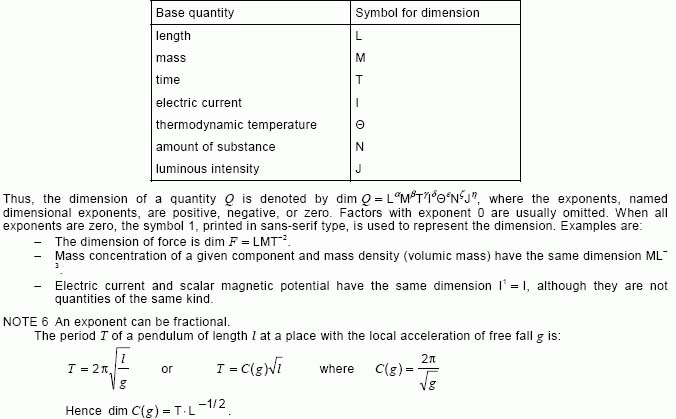
[IEV number 112-01-11]FR
dimension, f
dimension d'une grandeur, f
expression de la dépendance d’une grandeur par rapport aux grandeurs de base d'un système de grandeurs sous la forme d'un produit de puissances de facteurs correspondant aux grandeurs de base, en omettant tout facteur numérique
NOTE 1 – Une puissance d'un facteur est le facteur muni d'un exposant. Chaque facteur exprime la dimension d'une grandeur de base.
NOTE 2 – Par convention, la représentation symbolique de la dimension d'une grandeur de base est une lettre majuscule unique en caractère romain (droit) sans empattement. Par convention, la représentation symbolique de la dimension d'une grandeur dérivée est le produit de puissances des dimensions des grandeurs de base conformément à la définition de la grandeur dérivée. La dimension de la grandeur Q est notée dim Q.
NOTE 3 – Pour établir la dimension d'une grandeur, on ne tient pas compte du caractère scalaire, vectoriel ou tensoriel.
NOTE 4 – Dans un système de grandeurs donné, – les grandeurs de même nature ont la même dimension, – des grandeurs de dimensions différentes sont toujours de nature différente, – des grandeurs ayant la même dimension ne sont pas nécessairement de même nature. Par exemple, dans l'ISQ, la pression et l'énergie volumique ont la même dimension L–1MT–2. Voir aussi la note 5.
NOTE 5 – Dans le Système international de grandeurs (ISQ), les symboles représentant les dimensions des grandeurs de base sont:
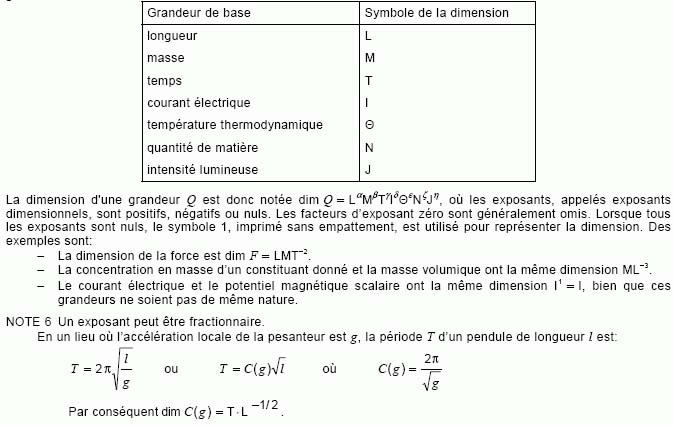
[IEV number 112-01-11]Тематики
- метрология, основные понятия
Синонимы
EN
DE
- Dimension einer Grösse
- Dimension, f
- Größendimension, f
FR
- dimension d'une grandeur, f
- dimension, f
Франко-русский словарь нормативно-технической терминологии > dimension d'une grandeur, f
-
15 dimension, f
размерность физической величины
размерность величины
Выражение в форме степенного одночлена, составленного из произведений символов основных физических величин в различных степенях и отражающее связь данной физической величины с физическими величинами, принятыми в данной системе величин за основные с коэффициентом пропорциональности, равным 1.
Примечания
1. Степени символов основных величин, входящих в одночлен, в зависимости от связи рассматриваемой физической величины с основными, могут быть целыми, дробными, положительными и отрицательными. Понятие размерность распространяется и на основные величины. Размерность основной величины в отношении самой себя равна единице, т.е. формула размерности основной величины совпадает с ее символом.
2. В соответствии с международным стандартом ИСО 31/0, размерность величин следует обозначать знаком dim [2]. В системе величин LMT размерность величины.x будет: dim х = LlMmTt, где L, М, Т - символы, величин, принятых за основные (соответственно длины, массы, времени).
[РМГ 29-99]EN
dimension of a quantity
quantity dimension
dimension
expression of the dependence of a quantity on the base quantities of a system of quantities as a product of powers of factors corresponding to the base quantities, omitting any numerical factor
NOTE 1 – A power of a factor is the factor raised to an exponent. Each factor is the dimension of a base quantity.
NOTE 2 – The conventional symbolic representation of the dimension of a base quantity is a single upper case letter in roman (upright) sans-serif type. The conventional symbolic representation of the dimension of a derived quantity is the product of powers of the dimensions of the base quantities according to the definition of the derived quantity. The dimension of a quantity Q is denoted by dim Q.
NOTE 3 – In deriving the dimension of a quantity, no account is taken of its scalar, vector or tensor character.
NOTE 4 – In a given system of quantities, – quantities of the same kind have the same dimension, – quantities of different dimensions are always of different kinds, and – quantities having the same dimension are not necessarily of the same kind. For example, in the ISQ, pressure and energy density (volumic energy) have the same dimension L–1MT–2. See also note 5.
NOTE 5 – In the International System of Quantities (ISQ), the symbols representing the dimensions of the base quantities are:
[IEV number 112-01-11]FR
dimension, f
dimension d'une grandeur, f
expression de la dépendance d’une grandeur par rapport aux grandeurs de base d'un système de grandeurs sous la forme d'un produit de puissances de facteurs correspondant aux grandeurs de base, en omettant tout facteur numérique
NOTE 1 – Une puissance d'un facteur est le facteur muni d'un exposant. Chaque facteur exprime la dimension d'une grandeur de base.
NOTE 2 – Par convention, la représentation symbolique de la dimension d'une grandeur de base est une lettre majuscule unique en caractère romain (droit) sans empattement. Par convention, la représentation symbolique de la dimension d'une grandeur dérivée est le produit de puissances des dimensions des grandeurs de base conformément à la définition de la grandeur dérivée. La dimension de la grandeur Q est notée dim Q.
NOTE 3 – Pour établir la dimension d'une grandeur, on ne tient pas compte du caractère scalaire, vectoriel ou tensoriel.
NOTE 4 – Dans un système de grandeurs donné, – les grandeurs de même nature ont la même dimension, – des grandeurs de dimensions différentes sont toujours de nature différente, – des grandeurs ayant la même dimension ne sont pas nécessairement de même nature. Par exemple, dans l'ISQ, la pression et l'énergie volumique ont la même dimension L–1MT–2. Voir aussi la note 5.
NOTE 5 – Dans le Système international de grandeurs (ISQ), les symboles représentant les dimensions des grandeurs de base sont:
[IEV number 112-01-11]Тематики
- метрология, основные понятия
Синонимы
EN
DE
- Dimension einer Grösse
- Dimension, f
- Größendimension, f
FR
- dimension d'une grandeur, f
- dimension, f
Франко-русский словарь нормативно-технической терминологии > dimension, f
-
16 Dimension einer Grösse
размерность физической величины
размерность величины
Выражение в форме степенного одночлена, составленного из произведений символов основных физических величин в различных степенях и отражающее связь данной физической величины с физическими величинами, принятыми в данной системе величин за основные с коэффициентом пропорциональности, равным 1.
Примечания
1. Степени символов основных величин, входящих в одночлен, в зависимости от связи рассматриваемой физической величины с основными, могут быть целыми, дробными, положительными и отрицательными. Понятие размерность распространяется и на основные величины. Размерность основной величины в отношении самой себя равна единице, т.е. формула размерности основной величины совпадает с ее символом.
2. В соответствии с международным стандартом ИСО 31/0, размерность величин следует обозначать знаком dim [2]. В системе величин LMT размерность величины.x будет: dim х = LlMmTt, где L, М, Т - символы, величин, принятых за основные (соответственно длины, массы, времени).
[РМГ 29-99]EN
dimension of a quantity
quantity dimension
dimension
expression of the dependence of a quantity on the base quantities of a system of quantities as a product of powers of factors corresponding to the base quantities, omitting any numerical factor
NOTE 1 – A power of a factor is the factor raised to an exponent. Each factor is the dimension of a base quantity.
NOTE 2 – The conventional symbolic representation of the dimension of a base quantity is a single upper case letter in roman (upright) sans-serif type. The conventional symbolic representation of the dimension of a derived quantity is the product of powers of the dimensions of the base quantities according to the definition of the derived quantity. The dimension of a quantity Q is denoted by dim Q.
NOTE 3 – In deriving the dimension of a quantity, no account is taken of its scalar, vector or tensor character.
NOTE 4 – In a given system of quantities, – quantities of the same kind have the same dimension, – quantities of different dimensions are always of different kinds, and – quantities having the same dimension are not necessarily of the same kind. For example, in the ISQ, pressure and energy density (volumic energy) have the same dimension L–1MT–2. See also note 5.
NOTE 5 – In the International System of Quantities (ISQ), the symbols representing the dimensions of the base quantities are:
[IEV number 112-01-11]FR
dimension, f
dimension d'une grandeur, f
expression de la dépendance d’une grandeur par rapport aux grandeurs de base d'un système de grandeurs sous la forme d'un produit de puissances de facteurs correspondant aux grandeurs de base, en omettant tout facteur numérique
NOTE 1 – Une puissance d'un facteur est le facteur muni d'un exposant. Chaque facteur exprime la dimension d'une grandeur de base.
NOTE 2 – Par convention, la représentation symbolique de la dimension d'une grandeur de base est une lettre majuscule unique en caractère romain (droit) sans empattement. Par convention, la représentation symbolique de la dimension d'une grandeur dérivée est le produit de puissances des dimensions des grandeurs de base conformément à la définition de la grandeur dérivée. La dimension de la grandeur Q est notée dim Q.
NOTE 3 – Pour établir la dimension d'une grandeur, on ne tient pas compte du caractère scalaire, vectoriel ou tensoriel.
NOTE 4 – Dans un système de grandeurs donné, – les grandeurs de même nature ont la même dimension, – des grandeurs de dimensions différentes sont toujours de nature différente, – des grandeurs ayant la même dimension ne sont pas nécessairement de même nature. Par exemple, dans l'ISQ, la pression et l'énergie volumique ont la même dimension L–1MT–2. Voir aussi la note 5.
NOTE 5 – Dans le Système international de grandeurs (ISQ), les symboles représentant les dimensions des grandeurs de base sont:
[IEV number 112-01-11]Тематики
- метрология, основные понятия
Синонимы
EN
DE
- Dimension einer Grösse
- Dimension, f
- Größendimension, f
FR
- dimension d'une grandeur, f
- dimension, f
Немецко-русский словарь нормативно-технической терминологии > Dimension einer Grösse
-
17 Dimension, f
размерность физической величины
размерность величины
Выражение в форме степенного одночлена, составленного из произведений символов основных физических величин в различных степенях и отражающее связь данной физической величины с физическими величинами, принятыми в данной системе величин за основные с коэффициентом пропорциональности, равным 1.
Примечания
1. Степени символов основных величин, входящих в одночлен, в зависимости от связи рассматриваемой физической величины с основными, могут быть целыми, дробными, положительными и отрицательными. Понятие размерность распространяется и на основные величины. Размерность основной величины в отношении самой себя равна единице, т.е. формула размерности основной величины совпадает с ее символом.
2. В соответствии с международным стандартом ИСО 31/0, размерность величин следует обозначать знаком dim [2]. В системе величин LMT размерность величины.x будет: dim х = LlMmTt, где L, М, Т - символы, величин, принятых за основные (соответственно длины, массы, времени).
[РМГ 29-99]EN
dimension of a quantity
quantity dimension
dimension
expression of the dependence of a quantity on the base quantities of a system of quantities as a product of powers of factors corresponding to the base quantities, omitting any numerical factor
NOTE 1 – A power of a factor is the factor raised to an exponent. Each factor is the dimension of a base quantity.
NOTE 2 – The conventional symbolic representation of the dimension of a base quantity is a single upper case letter in roman (upright) sans-serif type. The conventional symbolic representation of the dimension of a derived quantity is the product of powers of the dimensions of the base quantities according to the definition of the derived quantity. The dimension of a quantity Q is denoted by dim Q.
NOTE 3 – In deriving the dimension of a quantity, no account is taken of its scalar, vector or tensor character.
NOTE 4 – In a given system of quantities, – quantities of the same kind have the same dimension, – quantities of different dimensions are always of different kinds, and – quantities having the same dimension are not necessarily of the same kind. For example, in the ISQ, pressure and energy density (volumic energy) have the same dimension L–1MT–2. See also note 5.
NOTE 5 – In the International System of Quantities (ISQ), the symbols representing the dimensions of the base quantities are:
[IEV number 112-01-11]FR
dimension, f
dimension d'une grandeur, f
expression de la dépendance d’une grandeur par rapport aux grandeurs de base d'un système de grandeurs sous la forme d'un produit de puissances de facteurs correspondant aux grandeurs de base, en omettant tout facteur numérique
NOTE 1 – Une puissance d'un facteur est le facteur muni d'un exposant. Chaque facteur exprime la dimension d'une grandeur de base.
NOTE 2 – Par convention, la représentation symbolique de la dimension d'une grandeur de base est une lettre majuscule unique en caractère romain (droit) sans empattement. Par convention, la représentation symbolique de la dimension d'une grandeur dérivée est le produit de puissances des dimensions des grandeurs de base conformément à la définition de la grandeur dérivée. La dimension de la grandeur Q est notée dim Q.
NOTE 3 – Pour établir la dimension d'une grandeur, on ne tient pas compte du caractère scalaire, vectoriel ou tensoriel.
NOTE 4 – Dans un système de grandeurs donné, – les grandeurs de même nature ont la même dimension, – des grandeurs de dimensions différentes sont toujours de nature différente, – des grandeurs ayant la même dimension ne sont pas nécessairement de même nature. Par exemple, dans l'ISQ, la pression et l'énergie volumique ont la même dimension L–1MT–2. Voir aussi la note 5.
NOTE 5 – Dans le Système international de grandeurs (ISQ), les symboles représentant les dimensions des grandeurs de base sont:
[IEV number 112-01-11]Тематики
- метрология, основные понятия
Синонимы
EN
DE
- Dimension einer Grösse
- Dimension, f
- Größendimension, f
FR
- dimension d'une grandeur, f
- dimension, f
Немецко-русский словарь нормативно-технической терминологии > Dimension, f
-
18 Größendimension, f
размерность физической величины
размерность величины
Выражение в форме степенного одночлена, составленного из произведений символов основных физических величин в различных степенях и отражающее связь данной физической величины с физическими величинами, принятыми в данной системе величин за основные с коэффициентом пропорциональности, равным 1.
Примечания
1. Степени символов основных величин, входящих в одночлен, в зависимости от связи рассматриваемой физической величины с основными, могут быть целыми, дробными, положительными и отрицательными. Понятие размерность распространяется и на основные величины. Размерность основной величины в отношении самой себя равна единице, т.е. формула размерности основной величины совпадает с ее символом.
2. В соответствии с международным стандартом ИСО 31/0, размерность величин следует обозначать знаком dim [2]. В системе величин LMT размерность величины.x будет: dim х = LlMmTt, где L, М, Т - символы, величин, принятых за основные (соответственно длины, массы, времени).
[РМГ 29-99]EN
dimension of a quantity
quantity dimension
dimension
expression of the dependence of a quantity on the base quantities of a system of quantities as a product of powers of factors corresponding to the base quantities, omitting any numerical factor
NOTE 1 – A power of a factor is the factor raised to an exponent. Each factor is the dimension of a base quantity.
NOTE 2 – The conventional symbolic representation of the dimension of a base quantity is a single upper case letter in roman (upright) sans-serif type. The conventional symbolic representation of the dimension of a derived quantity is the product of powers of the dimensions of the base quantities according to the definition of the derived quantity. The dimension of a quantity Q is denoted by dim Q.
NOTE 3 – In deriving the dimension of a quantity, no account is taken of its scalar, vector or tensor character.
NOTE 4 – In a given system of quantities, – quantities of the same kind have the same dimension, – quantities of different dimensions are always of different kinds, and – quantities having the same dimension are not necessarily of the same kind. For example, in the ISQ, pressure and energy density (volumic energy) have the same dimension L–1MT–2. See also note 5.
NOTE 5 – In the International System of Quantities (ISQ), the symbols representing the dimensions of the base quantities are:
[IEV number 112-01-11]FR
dimension, f
dimension d'une grandeur, f
expression de la dépendance d’une grandeur par rapport aux grandeurs de base d'un système de grandeurs sous la forme d'un produit de puissances de facteurs correspondant aux grandeurs de base, en omettant tout facteur numérique
NOTE 1 – Une puissance d'un facteur est le facteur muni d'un exposant. Chaque facteur exprime la dimension d'une grandeur de base.
NOTE 2 – Par convention, la représentation symbolique de la dimension d'une grandeur de base est une lettre majuscule unique en caractère romain (droit) sans empattement. Par convention, la représentation symbolique de la dimension d'une grandeur dérivée est le produit de puissances des dimensions des grandeurs de base conformément à la définition de la grandeur dérivée. La dimension de la grandeur Q est notée dim Q.
NOTE 3 – Pour établir la dimension d'une grandeur, on ne tient pas compte du caractère scalaire, vectoriel ou tensoriel.
NOTE 4 – Dans un système de grandeurs donné, – les grandeurs de même nature ont la même dimension, – des grandeurs de dimensions différentes sont toujours de nature différente, – des grandeurs ayant la même dimension ne sont pas nécessairement de même nature. Par exemple, dans l'ISQ, la pression et l'énergie volumique ont la même dimension L–1MT–2. Voir aussi la note 5.
NOTE 5 – Dans le Système international de grandeurs (ISQ), les symboles représentant les dimensions des grandeurs de base sont:
[IEV number 112-01-11]Тематики
- метрология, основные понятия
Синонимы
EN
DE
- Dimension einer Grösse
- Dimension, f
- Größendimension, f
FR
- dimension d'une grandeur, f
- dimension, f
Немецко-русский словарь нормативно-технической терминологии > Größendimension, f
-
19 dimension
- устанавливать размеры
- размерность физической величины
- размерность (величины)
- размерность (векторного пространства)
- размерность
- размер
- протяжённость (во времени)
- мн. габариты
- габариты (мн.)
габариты (мн.)
—
[А.С.Гольдберг. Англо-русский энергетический словарь. 2006 г.]Тематики
EN
мн. габариты
—
[А.С.Гольдберг. Англо-русский энергетический словарь. 2006 г.]Тематики
EN
протяжённость (во времени)
—
[А.С.Гольдберг. Англо-русский энергетический словарь. 2006 г.]Тематики
EN
размер
Значение линейной, угловой или какой-либо другой величины в принятых единицах измерения
[Терминологический словарь по строительству на 12 языках (ВНИИИС Госстроя СССР)]EN
DE
FR
размерность
—
[ http://www.iks-media.ru/glossary/index.html?glossid=2400324]Тематики
- электросвязь, основные понятия
EN
размерность (векторного пространства)
—
[http://www.rfcmd.ru/glossword/1.8/index.php?a=index&d=23]Тематики
EN
размерность физической величины
размерность величины
Выражение в форме степенного одночлена, составленного из произведений символов основных физических величин в различных степенях и отражающее связь данной физической величины с физическими величинами, принятыми в данной системе величин за основные с коэффициентом пропорциональности, равным 1.
Примечания
1. Степени символов основных величин, входящих в одночлен, в зависимости от связи рассматриваемой физической величины с основными, могут быть целыми, дробными, положительными и отрицательными. Понятие размерность распространяется и на основные величины. Размерность основной величины в отношении самой себя равна единице, т.е. формула размерности основной величины совпадает с ее символом.
2. В соответствии с международным стандартом ИСО 31/0, размерность величин следует обозначать знаком dim [2]. В системе величин LMT размерность величины.x будет: dim х = LlMmTt, где L, М, Т - символы, величин, принятых за основные (соответственно длины, массы, времени).
[РМГ 29-99]EN
dimension of a quantity
quantity dimension
dimension
expression of the dependence of a quantity on the base quantities of a system of quantities as a product of powers of factors corresponding to the base quantities, omitting any numerical factor
NOTE 1 – A power of a factor is the factor raised to an exponent. Each factor is the dimension of a base quantity.
NOTE 2 – The conventional symbolic representation of the dimension of a base quantity is a single upper case letter in roman (upright) sans-serif type. The conventional symbolic representation of the dimension of a derived quantity is the product of powers of the dimensions of the base quantities according to the definition of the derived quantity. The dimension of a quantity Q is denoted by dim Q.
NOTE 3 – In deriving the dimension of a quantity, no account is taken of its scalar, vector or tensor character.
NOTE 4 – In a given system of quantities, – quantities of the same kind have the same dimension, – quantities of different dimensions are always of different kinds, and – quantities having the same dimension are not necessarily of the same kind. For example, in the ISQ, pressure and energy density (volumic energy) have the same dimension L–1MT–2. See also note 5.
NOTE 5 – In the International System of Quantities (ISQ), the symbols representing the dimensions of the base quantities are:
[IEV number 112-01-11]FR
dimension, f
dimension d'une grandeur, f
expression de la dépendance d’une grandeur par rapport aux grandeurs de base d'un système de grandeurs sous la forme d'un produit de puissances de facteurs correspondant aux grandeurs de base, en omettant tout facteur numérique
NOTE 1 – Une puissance d'un facteur est le facteur muni d'un exposant. Chaque facteur exprime la dimension d'une grandeur de base.
NOTE 2 – Par convention, la représentation symbolique de la dimension d'une grandeur de base est une lettre majuscule unique en caractère romain (droit) sans empattement. Par convention, la représentation symbolique de la dimension d'une grandeur dérivée est le produit de puissances des dimensions des grandeurs de base conformément à la définition de la grandeur dérivée. La dimension de la grandeur Q est notée dim Q.
NOTE 3 – Pour établir la dimension d'une grandeur, on ne tient pas compte du caractère scalaire, vectoriel ou tensoriel.
NOTE 4 – Dans un système de grandeurs donné, – les grandeurs de même nature ont la même dimension, – des grandeurs de dimensions différentes sont toujours de nature différente, – des grandeurs ayant la même dimension ne sont pas nécessairement de même nature. Par exemple, dans l'ISQ, la pression et l'énergie volumique ont la même dimension L–1MT–2. Voir aussi la note 5.
NOTE 5 – Dans le Système international de grandeurs (ISQ), les symboles représentant les dimensions des grandeurs de base sont:
[IEV number 112-01-11]Тематики
- метрология, основные понятия
Синонимы
EN
DE
- Dimension einer Grösse
- Dimension, f
- Größendimension, f
FR
- dimension d'une grandeur, f
- dimension, f
устанавливать размеры
задавать размеры
—
[А.С.Гольдберг. Англо-русский энергетический словарь. 2006 г.]Тематики
Синонимы
EN
Англо-русский словарь нормативно-технической терминологии > dimension
-
20 dimension of a quantity
размерность величины
Выражение в форме степенного одночлена, составленного из произведений символов основных величин в различных степенях, отражающее связь данной величины с основными величинами и имеющее коэффициент пропорциональности, равный 1 (ОСТ 45.159-2000.1 Термины и определения (Минсвязи России)).
[ http://www.iks-media.ru/glossary/index.html?glossid=2400324]Тематики
- электросвязь, основные понятия
EN
размерность физической величины
размерность величины
Выражение в форме степенного одночлена, составленного из произведений символов основных физических величин в различных степенях и отражающее связь данной физической величины с физическими величинами, принятыми в данной системе величин за основные с коэффициентом пропорциональности, равным 1.
Примечания
1. Степени символов основных величин, входящих в одночлен, в зависимости от связи рассматриваемой физической величины с основными, могут быть целыми, дробными, положительными и отрицательными. Понятие размерность распространяется и на основные величины. Размерность основной величины в отношении самой себя равна единице, т.е. формула размерности основной величины совпадает с ее символом.
2. В соответствии с международным стандартом ИСО 31/0, размерность величин следует обозначать знаком dim [2]. В системе величин LMT размерность величины.x будет: dim х = LlMmTt, где L, М, Т - символы, величин, принятых за основные (соответственно длины, массы, времени).
[РМГ 29-99]EN
dimension of a quantity
quantity dimension
dimension
expression of the dependence of a quantity on the base quantities of a system of quantities as a product of powers of factors corresponding to the base quantities, omitting any numerical factor
NOTE 1 – A power of a factor is the factor raised to an exponent. Each factor is the dimension of a base quantity.
NOTE 2 – The conventional symbolic representation of the dimension of a base quantity is a single upper case letter in roman (upright) sans-serif type. The conventional symbolic representation of the dimension of a derived quantity is the product of powers of the dimensions of the base quantities according to the definition of the derived quantity. The dimension of a quantity Q is denoted by dim Q.
NOTE 3 – In deriving the dimension of a quantity, no account is taken of its scalar, vector or tensor character.
NOTE 4 – In a given system of quantities, – quantities of the same kind have the same dimension, – quantities of different dimensions are always of different kinds, and – quantities having the same dimension are not necessarily of the same kind. For example, in the ISQ, pressure and energy density (volumic energy) have the same dimension L–1MT–2. See also note 5.
NOTE 5 – In the International System of Quantities (ISQ), the symbols representing the dimensions of the base quantities are:
[IEV number 112-01-11]FR
dimension, f
dimension d'une grandeur, f
expression de la dépendance d’une grandeur par rapport aux grandeurs de base d'un système de grandeurs sous la forme d'un produit de puissances de facteurs correspondant aux grandeurs de base, en omettant tout facteur numérique
NOTE 1 – Une puissance d'un facteur est le facteur muni d'un exposant. Chaque facteur exprime la dimension d'une grandeur de base.
NOTE 2 – Par convention, la représentation symbolique de la dimension d'une grandeur de base est une lettre majuscule unique en caractère romain (droit) sans empattement. Par convention, la représentation symbolique de la dimension d'une grandeur dérivée est le produit de puissances des dimensions des grandeurs de base conformément à la définition de la grandeur dérivée. La dimension de la grandeur Q est notée dim Q.
NOTE 3 – Pour établir la dimension d'une grandeur, on ne tient pas compte du caractère scalaire, vectoriel ou tensoriel.
NOTE 4 – Dans un système de grandeurs donné, – les grandeurs de même nature ont la même dimension, – des grandeurs de dimensions différentes sont toujours de nature différente, – des grandeurs ayant la même dimension ne sont pas nécessairement de même nature. Par exemple, dans l'ISQ, la pression et l'énergie volumique ont la même dimension L–1MT–2. Voir aussi la note 5.
NOTE 5 – Dans le Système international de grandeurs (ISQ), les symboles représentant les dimensions des grandeurs de base sont:
[IEV number 112-01-11]Тематики
- метрология, основные понятия
Синонимы
EN
DE
- Dimension einer Grösse
- Dimension, f
- Größendimension, f
FR
- dimension d'une grandeur, f
- dimension, f
Англо-русский словарь нормативно-технической терминологии > dimension of a quantity
См. также в других словарях:
Factor VIII — Coagulation factor VIII, procoagulant component PDB rendering based on 1d7p … Wikipedia
Factor — A financial institution that buys a firm s accounts receivables and collects the debt. The New York Times Financial Glossary * * * ▪ I. factor fac‧tor 1 [ˈfæktə ǁ ər] noun 1. [countable] one of many things that influence or affect a situation: •… … Financial and business terms
factor — (1) The percent of the original face of an MBS pool that remains outstanding at any given time is called the current factor. Principal payments, made by the borrowers, reduce the original face every month. Thus there is a new current factor each… … Financial and business terms
Factor analysis — is a statistical method used to describe variability among observed, correlated variables in terms of a potentially lower number of unobserved, uncorrelated variables called factors. In other words, it is possible, for example, that variations in … Wikipedia
Factor VIII — Factor eight, a key factor in the process of blood coagulation (clotting). Lack of normal factor VIII causes hemophilia (hemophilia A). The gene for classic hemophilia was long known to be on the X chromosome. Females carry the gene and transmit… … Medical dictionary
FACTOR, MAX — (1877–1938), U.S. cosmetics manufacturer. Factor was born in Lodz, Poland, where at the age of eight he served an apprenticeship to a dentist pharmacist. Years of mixing potions instilled in him a fascination with the human form. Factor opened… … Encyclopedia of Judaism
Factor price equalization — is an economic theory, which states that the relative prices for two identical factors of production in the same market will eventually equal each other because of competition. The price for each single factor need not become equal, but relative… … Wikipedia
Factor X (disambiguation) — Factor X, also known as Stuart Prower factor or as thrombokinase, is an enzyme.Factor X may also refer to: * Factor X (Ailyn album), a 2007 album by Ailyn * Factor X (Spain), a TV show * Factor X may refer to protoporphyrin IX or to haemin when… … Wikipedia
factor — aside from its technical senses, means ‘a fact or circumstance that contributes to a result’, and the notion of cause lies at the heart of its use, as in Gladstone s sentence (1878) The first factor in the making of a nation is its religion. A… … Modern English usage
factor — fac·tor n [Medieval Latin, doer, maker, agent, from Latin, maker, from facere to do, make] 1: one who acts or transacts business for another: as a: a commercial agent who buys or sells goods for others on commission b: one that lends money to… … Law dictionary
FACTOR — may also refer to the Object Oriented programming requirements caputre acronym Functionality, Application domain, Conditions, Technology, Objects and Responsibility; FACTOR (the Foundation to Assist Canadian Talent on Records) is a private non… … Wikipedia
